
Rome Resources Begins Exploration Programme in Emerging Canadian Critical Minerals District
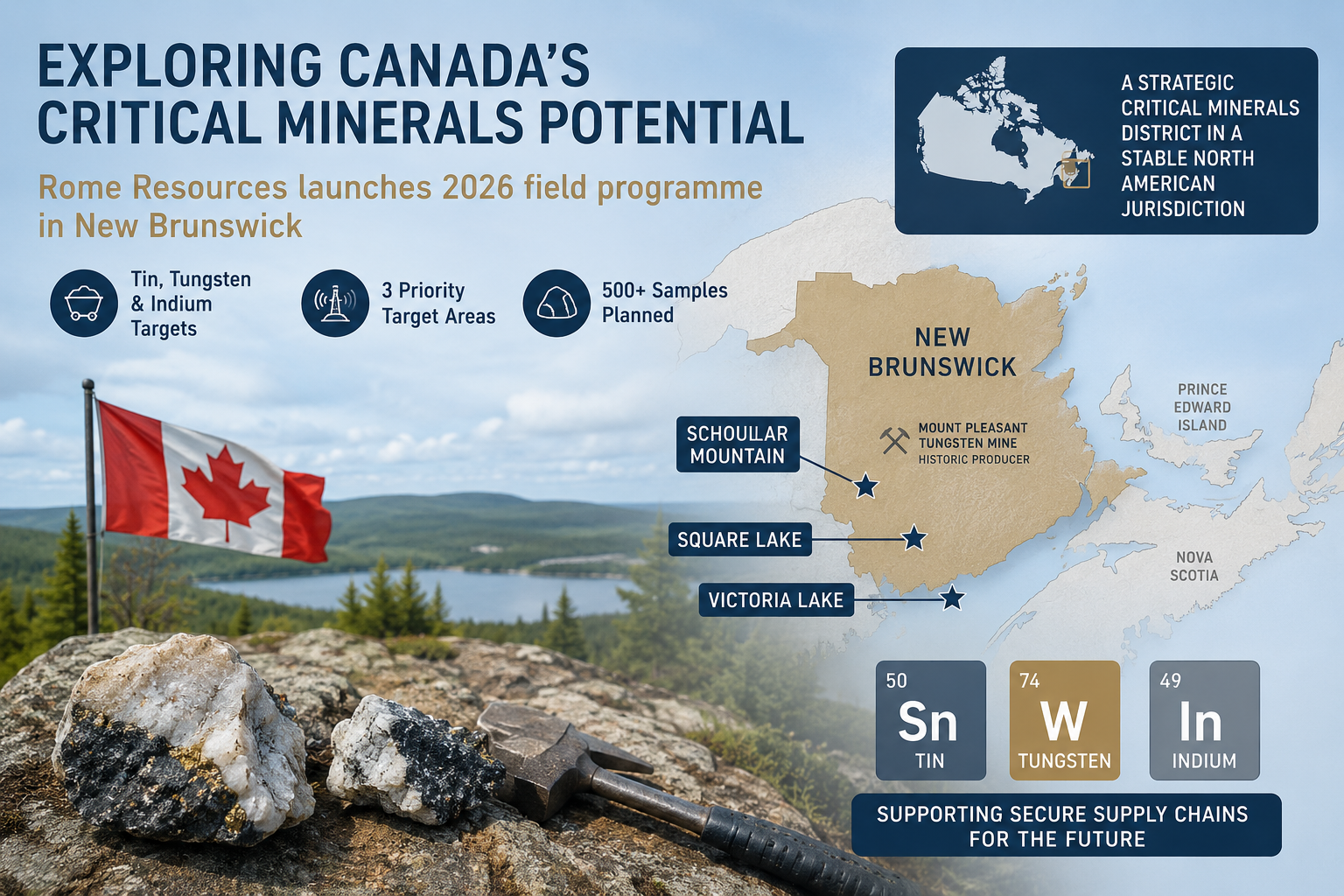
While Rome Resources remains focused on advancing its flagship Bisie North tin project in the DRC, the company is also quietly building exposure to another highly prospective critical minerals district in Canada. With a field programme now underway in New Brunswick targeting tin, tungsten and indium, Rome is positioning itself to evaluate a potentially strategic North American exploration opportunity at a time when Western governments are increasingly prioritising critical mineral security.
Rome Resources (AIM: RMR) has commenced its first field programme across the company's recently acquired optioned ground in New Brunswick, Canada, marking an important step in evaluating what could become a valuable second pillar within its growing critical minerals portfolio.
While investors remain focused on the company's rapidly advancing Bisie North tin project in the Democratic Republic of the Congo, the Canadian assets offer exposure to a highly prospective district containing three increasingly important strategic metals: tin, tungsten and indium.
Exploring a Historic Mining District
The licences cover approximately 109km² within the Mount Douglas granite system in southwestern New Brunswick, a region known for hosting significant tin and tungsten mineralisation.
Importantly, the land package sits adjacent to the historic Mount Pleasant Tungsten Mine, one of North America's best-known tungsten-producing districts and an area long recognised for its broader critical metals potential.
Despite this history, much of the district remains underexplored by modern standards.
For Rome, this presents an opportunity to apply contemporary exploration techniques across a mineral system that has already demonstrated its ability to host economically significant mineralisation.
Why Tin, Tungsten and Indium Matter
The timing of the programme is particularly interesting.
Tin continues to attract growing investor attention due to its critical role in semiconductors, electronics and renewable energy infrastructure.
Meanwhile, tungsten has become increasingly important from both an industrial and geopolitical perspective.
Used extensively in defence systems, aerospace applications, industrial tooling and advanced manufacturing, tungsten is now widely regarded as a strategic critical mineral by Western governments seeking to reduce supply chain dependence on China.
Indium, although less widely discussed, plays a vital role in electronics, touchscreens, solar technologies and advanced semiconductor applications.
Together, these commodities sit at the heart of many future technology and security supply chains.
Three Priority Target Areas
Rome's 2026 field programme will focus on three key target areas:
Schoullar Mountain
Located close to the historic Mount Pleasant Mine, this area sits within the same broader mineralised system.
The programme will focus on historical geophysical anomalies and near-surface targets identified through induced polarisation (IP) surveys, with trenching planned across selected zones.
Square Lake
Square Lake lies along the greisenised margin of the Mount Douglas granite and hosts numerous historic tin and tungsten workings.
Sampling will target areas where previous exploration identified encouraging indications of mineralisation.
Victoria Lake
Previously referred to as Three Lakes, Victoria Lake may be one of the most intriguing targets.
Multiple tin and tungsten occurrences have already been identified, including surface samples grading up to 1.4% tin.
The programme will focus on surface sampling and targeted trenching designed to assess the continuity and scale of the mineralised system.
A Low-Cost, High-Impact Exploration Programme
The initial programme is expected to involve more than 500 surface and trench samples across the three target areas.
Importantly, Rome's financial commitment remains relatively modest, with exploration expenditure expected to be capped at approximately CA$150,000.
This allows the company to gather substantial technical data before making a decision on whether to exercise its option and increase its involvement in the project.
From a shareholder perspective, it represents a measured approach to assessing a potentially significant opportunity without distracting from ongoing progress at Bisie North.
Provincial Support Highlights Strategic Importance
Another encouraging aspect of the programme is the support being provided by the Province of New Brunswick.
Rome has been awarded an exploration grant that will offset part of the field programme expenditure, demonstrating local government support for critical mineral development within the region.
At a time when North America is actively seeking domestic sources of strategic metals, this support reflects the growing importance of districts such as Mount Douglas.
Building Optionality Beyond the DRC
The New Brunswick programme should not be viewed as a change in focus away from Bisie North.
Rather, it provides Rome with additional exposure to critical metals in a stable North American jurisdiction while the company continues advancing its flagship DRC assets.
Management has made clear that work continues on:
- The updated Mineral Resource Estimate at Bisie North
- Ongoing geophysical surveys
- The broader development strategy for its tin and copper portfolio
The Canadian assets therefore offer something increasingly valuable in today's market: optionality.
A Strategic Opportunity Worth Testing
At this stage, New Brunswick remains an early-stage exploration opportunity.
However, the ingredients are certainly attractive:
- Proven mineral district
- Historic production nearby
- Tin, tungsten and indium exposure
- Government support
- Low-cost exploration programme
- North American jurisdiction
The coming field programme should provide Rome with its first meaningful dataset from the project and help determine whether this emerging critical minerals district can develop into a material value driver alongside Bisie North.
For now, the company is taking a disciplined and cost-effective approach to testing what could become a strategically important addition to its growing portfolio.