
United Oil & Gas Moves Jamaica From Theory Toward Evidence - Seeks Farm-out
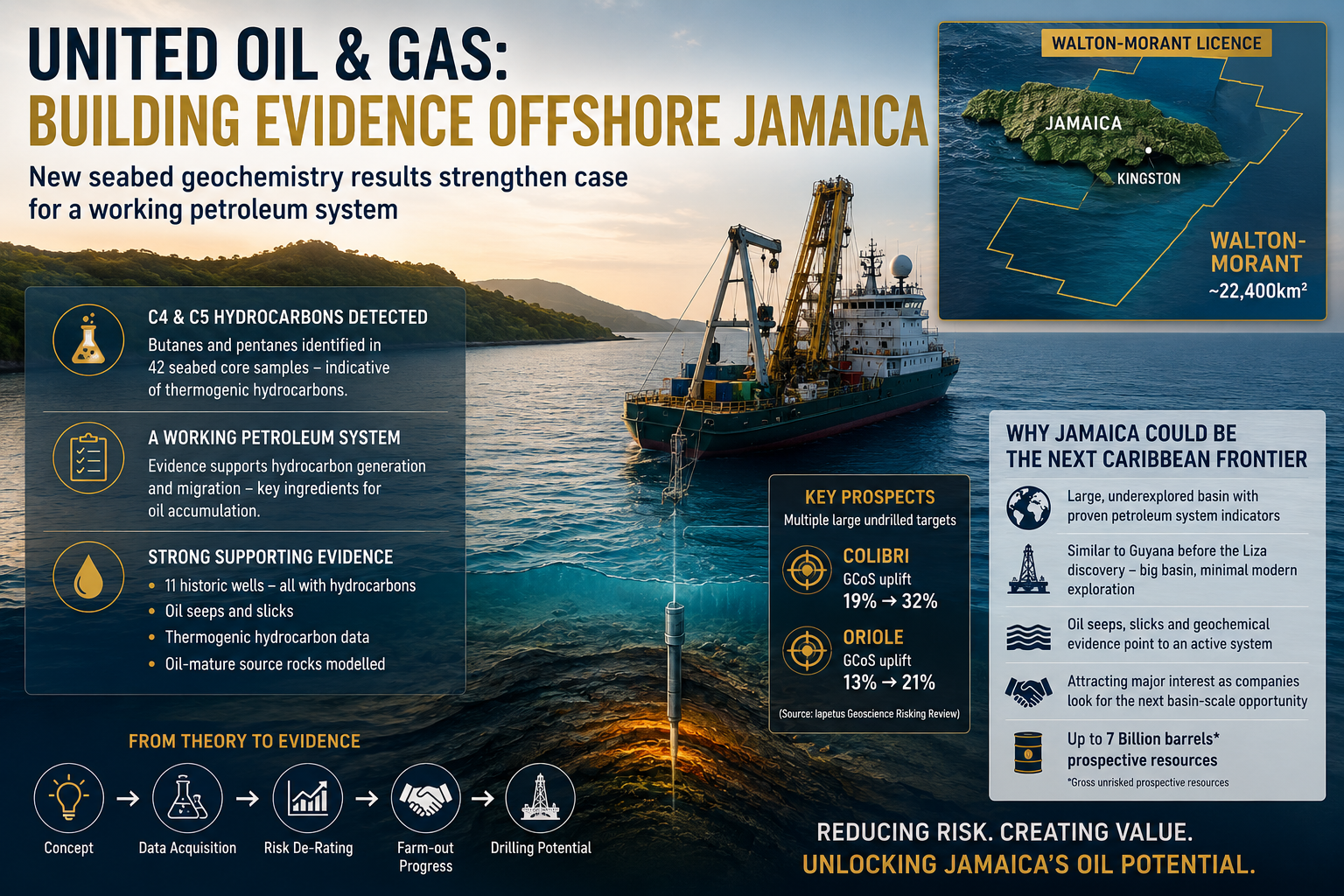
United Oil & Gas recently took another important step forward offshore Jamaica, with seabed geochemistry identifying heavier hydrocarbons that support the case for a working petroleum system across Walton-Morant. As technical evidence builds and the farm-out story strengthens, Jamaica’s underexplored offshore basin is beginning to attract attention as a potential new Caribbean frontier, drawing comparisons with the early-stage opportunity once seen offshore Guyana.
United Oil & Gas recently delivered a further technical update from its offshore Jamaica Walton-Morant licence, adding another important layer of evidence to one of the Caribbean’s most intriguing frontier exploration stories.
The company analysed 42 seabed core samples and identified C4 and C5 hydrocarbons — specifically butanes and pentanes.
These are heavier hydrocarbons than typical shallow microbial gas and are generally associated with thermogenic processes, meaning they are formed deeper underground under heat and pressure.
In simple terms, this supports the theory that offshore Jamaica may contain a working petroleum system.
Why the Latest Data Matters
For oil to accumulate, a number of key elements need to be present:
- A source rock capable of generating hydrocarbons
- Heat and pressure to mature those hydrocarbons
- Migration pathways to move them
- A trap and reservoir to store them
The latest seabed geochemistry strengthens confidence in some of the most important early components of that system — particularly hydrocarbon generation and migration.
In frontier exploration, those are often among the biggest unknowns.
So while this is not a discovery, it is another meaningful step in reducing geological uncertainty.
Building on a Wider Evidence Base
The latest results do not stand alone.
Walton-Morant already benefits from a growing body of supporting evidence, including:
- Historic wells showing hydrocarbons
- Known onshore and offshore oil seeps
- Satellite-detected oil slicks
- Previous thermogenic hydrocarbon data
- Geological modelling suggesting oil-mature source rocks
Historically, 11 wells have been drilled across Jamaica, including nine onshore and two offshore, all of which reportedly confirmed the presence of hydrocarbons.
Taken together, this points toward a consistent technical picture: hydrocarbons appear to have been generated within the basin.
The key question now is whether they have migrated into commercial traps.
Risk Re-Rating Potential
One of the key attractions of the recent seabed geochemistry work is its potential impact on geological chance of success.
United previously reported that a successful seabed geochemistry programme could lift the Colibri prospect from around 19% to 32% geological chance of success, based on an independent review by Iapetus Geoscience. That would represent a notable uplift for a frontier exploration target.
The potential uplift is not limited to Colibri.
The broader Walton-Morant licence also includes other prospects such as Oriole, where the same review indicated a possible improvement from 13% to 21% geological chance of success.
For context, frontier exploration opportunities can often carry much lower probabilities of success, sometimes in the single digits.
That is why each new technical data point matters.
United are now integrating the seabed geochemistry results into its broader geological model to formally update the risk profile across its prospect inventory.
Why Jamaica Could Become a New Oil & Gas Frontier
The comparison with Guyana is not about claiming Jamaica is the “next Guyana” overnight.
It is about recognising the characteristics that make frontier basins attractive before they are proven.
Before Exxon’s Liza discovery in 2015, offshore Guyana was also an underexplored frontier basin. Since then, the Stabroek Block has grown into one of the world’s most significant oil discoveries, with ExxonMobil estimating nearly 11 billion oil-equivalent barrels of gross recoverable resource.
Jamaica shares some of the same broad investment characteristics that make frontier basins compelling:
- Large offshore acreage
- Multiple undrilled structural targets
- Evidence of hydrocarbon generation
- Oil seeps and slicks
- Improving geochemical support
- Limited modern exploration
United’s Walton-Morant licence covers around 22,400km² and contains more than 7 billion barrels of mean/mid-case unrisked prospective resources, according to the company.
That scale is exactly why the licence remains interesting to potential farm-in partners.
The lesson from Guyana is not that every frontier basin becomes a major oil province, but major discoveries are often made where large underexplored basins, modern seismic data and evidence of a working petroleum system come together.
That is the opportunity United is working to demonstrate in Jamaica.
Strengthening the Farm-Out Case
The next major value catalyst remains a potential farm-out—with multiple parties in the data room.
For a small-cap explorer, drilling an offshore frontier well is typically too expensive to fund alone.
That is why United is seeking a partner that could potentially fund future drilling in exchange for an interest in the licence.
The latest seabed geochemistry results should help those discussions by giving potential partners more technical evidence to evaluate.
This is exactly the kind of data a larger exploration company wants to see before committing capital to a frontier basin.
A farm-out could potentially include:
- A carried well
- Back-cost contribution
- Cash consideration
- Retained exposure for United
The exact structure remains unknown, but even a modest retained interest could be highly significant given the scale of the prospective resource base.
A Potentially Transformational Prize
United is still at the exploration stage, no commercial discovery has been made, and drilling is required to prove whether the system can deliver commercial oil or gas accumulations.
However, the direction of travel is clear.
The company is moving from concept toward evidence:
- Hydrocarbon indicators are present
- Seabed geochemistry is supportive
- Historic wells confirm hydrocarbons
- Oil seeps and slicks support migration
- Independent risk work suggests potential uplift
- Farm-out discussions now have stronger technical backing
For a company with a modest market valuation, the scale of the potential prize at Walton-Morant remains considerable.
Frontier exploration is always high risk, but value is created by reducing uncertainty step by step.
This latest update does exactly that and could lead to a significant rerating moment for the company and shareholders given farm-out discussions are in progress and the back-drop for oil given ever increasing tensions in the middle-east.