
Kalayi Delivers Again as Rome Resources Builds Towards July Resource Upgrade
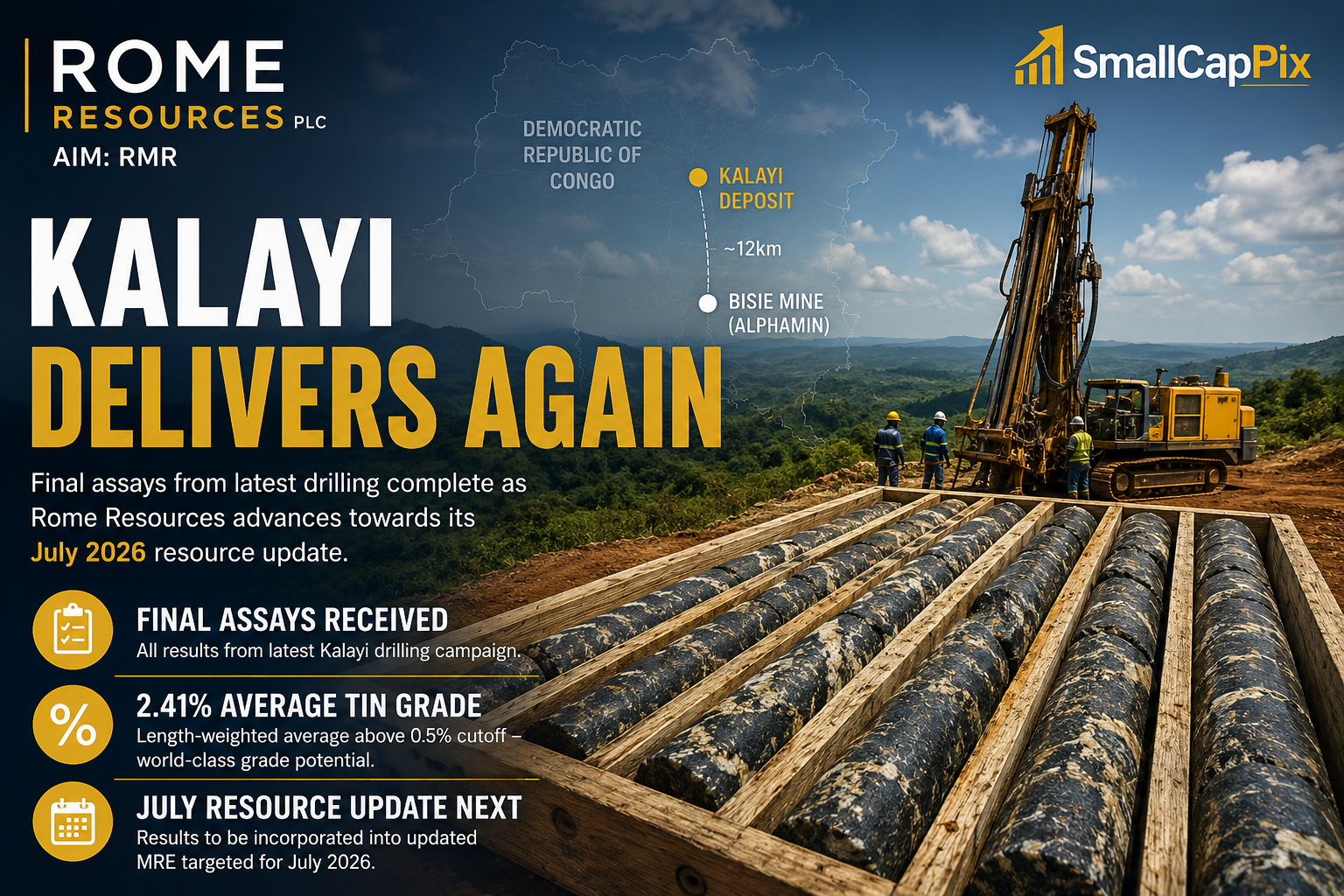
The final drill assays from Rome Resources' latest Kalayi campaign have reinforced what investors have increasingly come to expect from the Bisie North Project—high-grade tin mineralisation delivered over broader widths. While the standout intercepts are impressive in their own right, the real significance lies in what comes next, with these results now feeding into an updated Mineral Resource Estimate expected later this month that could materially increase contained tin.
For exploration companies, drill results are only part of the story. What ultimately creates value is how those results translate into a growing mineral resource and, eventually, a viable mining operation.
That is why Rome Resources' latest update from its Kalayi deposit is particularly significant. The company has now received the final assays from its most recent drilling programme, completing the dataset required for the updated Mineral Resource Estimate (MRE) expected during July.
The latest campaign has not only confirmed impressive tin grades but, importantly, has demonstrated broader mineralised zones than seen previously. Combined with an exceptionally high average grade across mineralised samples, the results provide encouraging support for what could become a meaningful upgrade to the existing resource.
Kalayi Continues to Strengthen
Rome Resources has spent the past year systematically building confidence in its Kalayi discovery within the broader Bisie North Project in the Democratic Republic of Congo.
The maiden Mineral Resource announced in November 2025 established an initial Inferred Resource of 330,000 tonnes grading 1.36% tin, containing 4,470 tonnes of tin metal.
However, maiden resources are rarely the finished product. Their purpose is to establish a foundation, with subsequent drilling focused on expanding the deposit, improving geological confidence and increasing contained metal.
That is exactly what this latest drilling campaign appears designed to achieve.
More Width While Maintaining Grade
Perhaps the most encouraging aspect of today's announcement is not simply the high grades but the increasing widths of mineralisation being intersected.
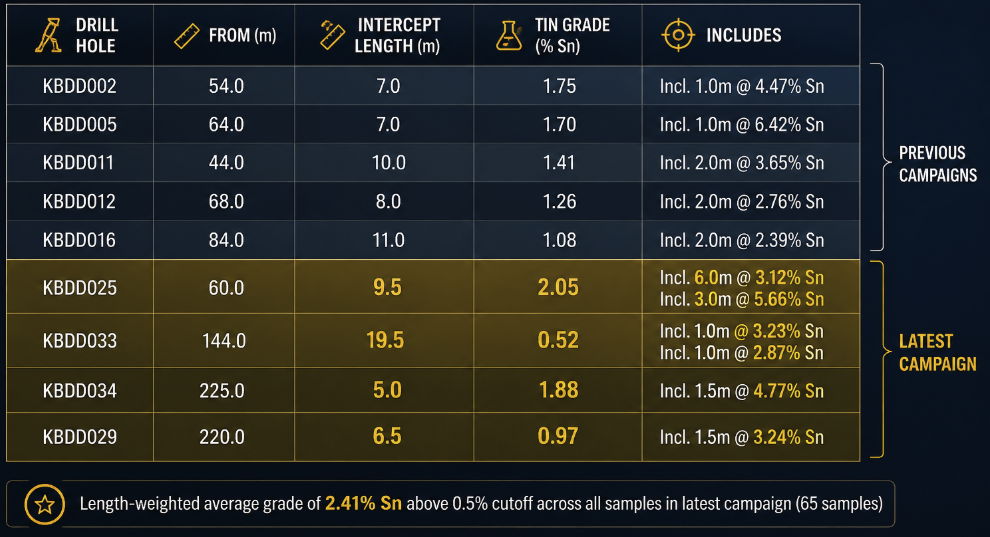
Significant Intercepts > 0.5% Sn
Standout results included:
- 9.5 metres at 2.05% tin, including 6 metres at 3.12% tin and 3 metres at an exceptional 5.66% tin
- 19.5 metres at 0.52% tin, including higher-grade internal zones exceeding 3% tin
- 5 metres at 1.88% tin, including 1.5 metres at 4.77% tin
- 6.5 metres at 0.97% tin, including 1.5 metres at 3.24% tin
For investors, these wider intersections matter because they can have a significant impact on future resource modelling.
Broader mineralised zones often improve mining flexibility while increasing contained metal, particularly when high-grade sections remain embedded within those wider intervals.
Management specifically highlighted that this was one of the primary objectives of the drilling programme, suggesting the geological model continues to evolve positively.
World-Class Grades Continue to Stand Out
One statistic deserves particular attention.
Across every mineralised sample exceeding the company's 0.5% tin cut-off, the length-weighted average grade was 2.41% tin.
In the tin sector, that is exceptionally high.
Globally, very few undeveloped tin deposits maintain average grades above 2%, placing Kalayi amongst a relatively small group of high-grade projects if these grades continue through future resource growth.
High grades can become increasingly valuable in today's market where miners seek projects capable of generating robust economics even during weaker commodity price cycles.
While grade alone does not determine project success, it remains one of the most important ingredients.
July's Resource Update Now Takes Centre Stage
Today's announcement effectively completes the latest exploration chapter.
The focus now shifts firmly towards the updated Mineral Resource Estimate expected during July.
Importantly, management has been unusually clear in its expectations.
Rather than simply stating the resource will be updated, Rome says it believes the new estimate will demonstrate a meaningful increase in contained tin compared with the maiden resource released last year.
Although investors will naturally wait for the independent resource statement, today's language suggests management believes the latest drilling has materially strengthened confidence in the geological model.
Should that prove correct, Kalayi would move another important step towards becoming a potentially significant tin development project.
Development Work Continues Alongside Exploration
Exploration is only one part of the story.
Rome continues progressing its planned pilot mining operation, which management expects will support conversion of its Small Scale Exploitation Permit into a full Mining Licence.
Pilot mining also provides valuable information on mining methods, metallurgy and processing before any larger-scale development begins.
Meanwhile, interpretation of the recently completed airborne geophysical survey is underway.
That work could identify additional targets across the wider Bisie North licence package, potentially extending the exploration pipeline well beyond the current Kalayi resource.
Location Adds Further Credibility
One of Kalayi's major attractions remains its location.
The project sits close to the producing Bisie Tin Mine operated by Alphamin, one of the world's highest-grade tin operations.
Rome continues to highlight the simple cassiterite mineralogy encountered at Kalayi, which could prove advantageous when considering future processing options.
Operating alongside an established mining district provides important infrastructure and industry validation that many early-stage explorers simply do not possess.
The SmallCapPix Take
The drilling campaign has now achieved its objective, with wider mineralised zones successfully demonstrated while preserving the high tin grades that have consistently characterised Kalayi.
The most significant takeaway is that management now believes these results are sufficient to deliver a meaningful increase in contained tin when the updated Mineral Resource Estimate is published later this month.
If that expectation is met, investors will have a substantially larger resource underpinning the next stage of project development.
Combined with ongoing permitting work, pilot mining preparations and additional exploration across both the DRC and Canada, Rome Resources enters the second half of 2026 with multiple catalysts still ahead.
For shareholders, attention now firmly turns to July's resource update—which increasingly looks set to become one of the company's most important milestones to date.