
Three Small-Cap Gold Companies You Should Have on Your Watch List

From a sub-£10m explorer preparing for its maiden drilling campaign, through to a £60m+ multi-target discovery story and a producing junior backed by a new strategic investor, Talon Resources, Orosur Mining and GoldStone Resources offer three very different ways to gain exposure to the gold sector.
Gold has once again become one of the most closely watched asset classes in global markets. After an extraordinary run through 2025 and into 2026, the metal remains around historically elevated levels, supported by geopolitical uncertainty, concerns around government debt and currencies, and continued demand from investors and central banks.
The World Gold Council's 2026 survey found that 89% of responding central banks expect global central-bank gold reserves to rise over the next 12 months, while a record 45% expect their own reserves to increase.
For equity investors, however, owning gold itself is only one way to play the theme.
Junior gold companies can potentially offer something very different: operational and discovery leverage to a high gold price. A successful drill campaign, resource expansion, development milestone or move towards larger-scale production can materially change how the market values a company.
That opportunity comes with considerably more risk, but it is also why retail investors frequently look further down the valuation curve in search of companies where a major proportion of the potential value has yet to be recognised.
SmallCapPix has recently covered three such companies — Talon Resources, GoldStone Resources and Orosur Mining.
They are particularly interesting when considered together because they sit at very different stages of the mining lifecycle.
Talon Resources – The Early-Stage Discovery Opportunity
AIM: TAR | Market Cap: approximately £7–8m
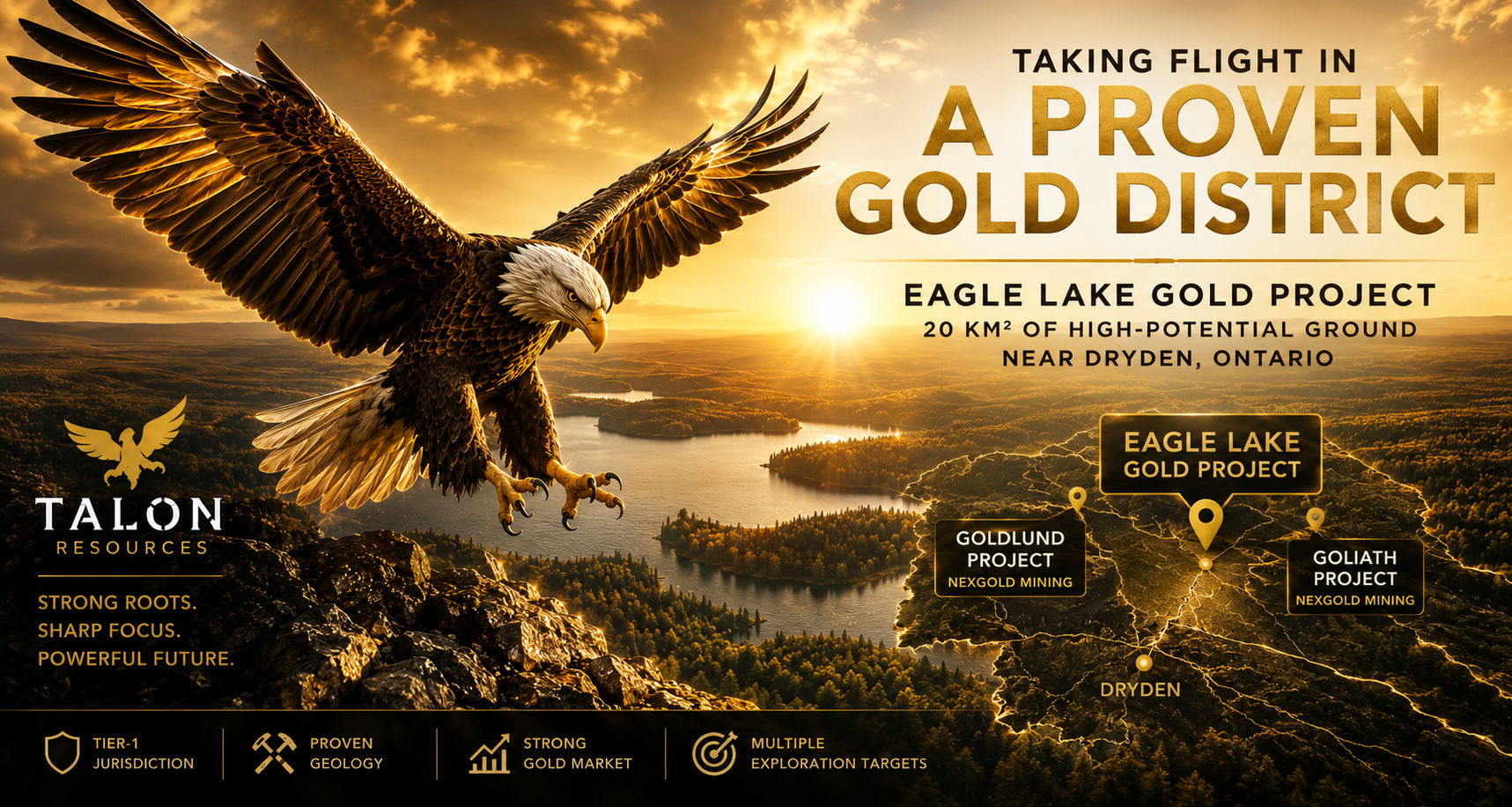
At the speculative end of our three companies sits Talon Resources, a recently admitted AIM explorer focused initially on the Eagle Lake Gold Project in Ontario, Canada.
Talon owns a 90% interest in Eagle Lake, covering approximately 20km² in Ontario's Wabigoon Subprovince — part of the wider Superior Province, one of Canada's most established gold-producing geological regions.
The attraction here is straightforward.
Talon is still near the beginning of the valuation curve.
Its market capitalisation is currently only around £7–8 million, meaning a substantial commercial discovery could potentially be highly material relative to the existing value of the company.
Eagle Lake already has some intriguing geological evidence.
Historical surface sampling returned assays of up to 204g/t gold, while Talon's recently completed Phase 1 exploration programme confirmed gold mineralisation across several targets.
At East Fornieri Bay, channel sampling returned:
- 1.85m @ 7.17g/t Au, including 0.50m @ 24.40g/t
- 4.80m @ 4.47g/t Au, including 1.0m @ 19.10g/t
At Cedar Trench, Talon reported:
- 5.70m @ 1.26g/t Au, including 1.70m @ 3.15g/t
- 10.10m @ 0.57g/t Au, including 2.50m @ 1.53g/t
The programme also identified a new target at Moss Knoll, helping to strengthen the geological picture across the wider project.
The Talon Investment Case
Talon is arguably the highest-risk proposition of our three companies, but it also represents the purest early-stage exploration opportunity.
The next major value inflection point should be drilling.
Management is working towards its maiden diamond drilling campaign at Eagle Lake, currently targeted for Q4 2026.
Surface results can identify where gold may be present, but ultimately drilling will determine whether Eagle Lake contains mineralised structures with the scale, continuity and grade required to support a meaningful discovery.
At a sub-£10m valuation, successful drilling could therefore change the investment proposition considerably.
That is precisely what makes Talon interesting: investors are effectively gaining exposure before the drill bit has properly tested the geological thesis.
To read more on the Talon story read our recent blog: Talon Resources Confirms High-Grade Gold Across Multiple Targets as Eagle Lake Moves Closer to Drilling
GoldStone Resources – Gold Production With Expansion Potential
AIM: GRL | Market Cap: approximately £10–12m
GoldStone Resources sits at a very different point on the curve.
Unlike Talon, GoldStone is already producing gold through its Homase Mine in Ghana, giving investors direct exposure to current gold production alongside exploration and development upside.
For the quarter ended March 2026, GoldStone reported:
- 36,268 tonnes of ore stacked
- 480 ounces of gold produced
- 19.99kg of gold contained within the heap-leach circuit
Those production numbers remain relatively modest, but the more interesting part of the developing story may be what comes next.
Homase currently contains a JORC-compliant resource of approximately 602,000 ounces of gold at an average grade of 1.77g/t, with considerable geological potential remaining along the Homase trend.
And in July, GoldStone announced what could prove to be an important strategic development.
Hong Kong-listed Persistence Gold Group agreed to invest £3.51 million at 1p per share, giving it approximately 20.96% of GoldStone following admission of the shares.
The funding is intended to support expanded drilling at Homase, exploration, resource work, mine planning and working capital.
The GoldStone Investment Case
What differentiates GoldStone from many junior gold companies is that the company has already crossed the line from explorer to producer.
That potentially provides two routes to value creation.
The first is operational: increasing production and improving the economics of Homase against a backdrop of historically high gold prices.
The second is geological: drilling and exploration could expand the existing resource and potentially provide the foundation for a larger-scale operation.
GoldStone's current market valuation remains only around £10–12 million, despite an existing gold resource, current production and the recent strategic investment from Persistence.
For investors willing to accept the operational risks associated with a small producer, that combination makes GoldStone an interesting recovery and growth proposition.
To read more on the Goldstone story read our recent blog: GoldStone Resources: Strategic Funding Sets Up Homase Growth Push
Orosur Mining – Building a District-Scale Gold Story
AIM/TSXV: OMI | Market Cap: approximately £65–70m
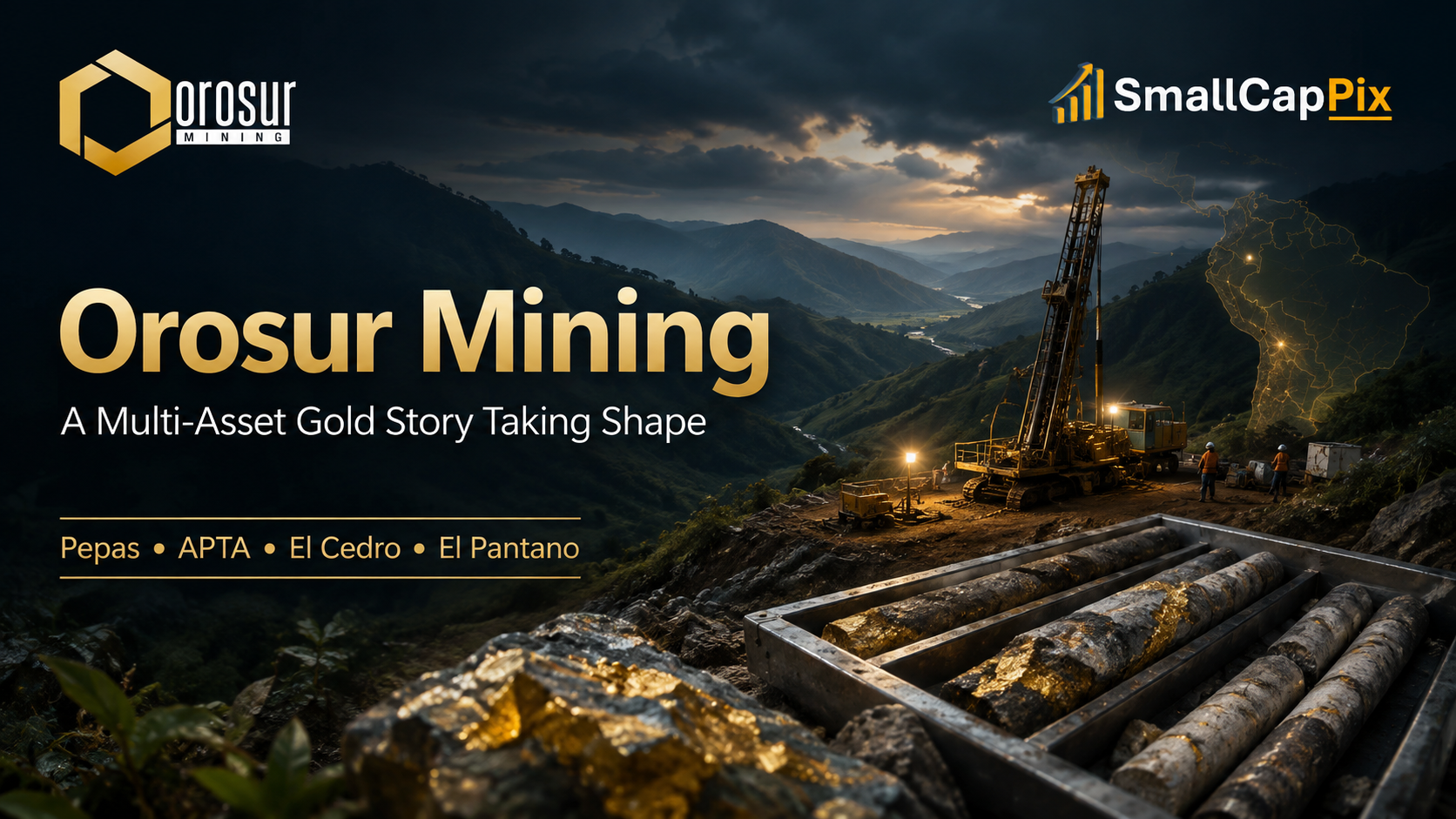
Orosur Mining is the largest of our three companies by some distance, with its roughly £65–70 million valuation reflecting the considerable exploration success already achieved at the company's 100%-owned Anzá Project in Colombia.
But Orosur's attraction is increasingly about much more than a single discovery.
The approximately 330km² Anzá Project contains three key prospects:
Pepas – A shallow, high-grade gold deposit with an established resource
APTA – A substantial high-grade gold system undergoing further drilling
El Cedro – A potentially large gold-copper porphyry target moving towards maiden drilling
Pepas has already demonstrated the ability of Orosur to rapidly convert exploration success into a defined resource.
Its maiden Mineral Resource Estimate announced in February contained:
1.14Mt @ 5.46g/t gold for 201,000oz Indicated
plus
0.19Mt @ 2.99g/t gold for 18,000oz Inferred
Importantly, the mineralisation begins at surface and sits within a conceptual open-pit shell.
Yet exploration continues to show that Pepas may extend beyond the initial resource footprint.
Recent Pepas West drilling included 10.2m @ 5.77g/t Au from surface, alongside several other shallow mineralised intersections.
Then there is APTA.
Recent drilling has produced some substantial intersections, including 135m @ 1.91g/t Au, containing 49m @ 4.06g/t Au, further strengthening the case that Anzá could contain considerably more gold than the existing Pepas resource alone.
Finally comes El Cedro — perhaps the biggest geological wildcard of the portfolio.
Extensive surface exploration has identified a cluster of gold-bearing porphyry intrusions and the company has been preparing for the first drilling programme ever undertaken at the prospect.
The Orosur Investment Case
Orosur clearly commands a larger valuation than either Talon or GoldStone.
But investors are paying for a much more advanced exploration story.
Pepas already has a high-grade resource.
APTA is producing substantial gold intersections.
Pepas West is expanding the known mineralised footprint.
And El Cedro provides exposure to an entirely different potentially large-scale porphyry opportunity.
The investment question therefore becomes less about whether Orosur has discovered gold and more about how large the overall Anzá gold system could ultimately become.
If the answer proves to be substantially larger than today's defined resource, the current £65–70m valuation may eventually be judged against a considerably larger resource base.
To read more on the Orosur story read our recent blog: Orosur Mining: A Multi-Asset Gold Story Starting to Take Shape
Three Companies – Three Points on the Valuation Curve
That is what makes these three companies interesting as a group.
Talon Resources offers the earliest entry point.
At approximately £7–8m, investors are backing geology, surface evidence and an upcoming maiden drilling campaign. Successful drilling could potentially result in the most dramatic valuation change, but exploration risk is correspondingly highest.
GoldStone Resources sits further along the curve.
Gold has already been discovered, a resource established and production commenced. The opportunity is now centred around scaling the operation, expanding the resource and making more of the Homase asset — helped by the recent strategic investment from Persistence Gold.
Orosur Mining sits further along again.
Its valuation already reflects major exploration success, but Anzá is developing into a multi-target gold project where Pepas, APTA and El Cedro could each contribute towards a considerably larger district-scale opportunity.
The SmallCapPix Take
There are many ways to gain exposure to gold.
Buying physical gold or a gold ETF gives investors relatively direct exposure to movements in the commodity itself.
Junior mining equities are different.
They introduce exploration, financing, operational and jurisdictional risks — but they can also introduce something gold itself cannot provide: the possibility of creating additional value through discovery and development.
That becomes particularly interesting during periods of high gold prices.
A gold discovery that may have struggled economically at substantially lower commodity prices can look very different when the underlying metal trades at historically elevated levels.
And that is why the valuation curve matters.
Talon, GoldStone and Orosur represent three different points on it.
Talon offers maximum early-stage discovery leverage from a valuation below £10m.
GoldStone combines an unusually low small-cap valuation with existing production and a sizeable established resource.
Orosur offers the more advanced and arguably broader geological proposition, where repeated drilling success is increasingly pointing towards the possibility of a much larger gold district at Anzá.
None are without risk, and their respective valuations reflect very different levels of geological and operational maturity.
But for investors looking beyond the gold price itself and searching for junior companies where exploration, resource growth or operational progress could potentially move them up the valuation curve, all three deserve a place on the watchlist.