
Rare Earth M&A is Heating Up – Could Harena Resources Be Next?

As rare earth M&A accelerates and major players target strategic ionic-clay assets, Harena’s 100%-owned, U.S.-backed Ampasindava project in Madagascar could be increasingly difficult for potential strategic buyers to ignore.
The race to secure Western supplies of critical rare earths is moving into a new phase.
For several years, governments and mining companies have talked about the need to reduce the West’s reliance on China for the rare earth elements needed in permanent magnets, electric vehicles, wind turbines, robotics, advanced electronics and defence applications.
Increasingly, however, that strategic imperative is translating into actual money.
Major transactions are now taking place across the rare-earth sector, with particular interest emerging around ionic adsorption clay projects – a style of rare-earth deposit that can offer some important advantages over conventional hard-rock projects.
For investors in London-listed Harena Rare Earths (LSE: HREE), this is worth watching.
Harena owns 100% of the large Ampasindava ionic-clay rare-earth project in Madagascar. With a substantial resource, a completed PFS, U.S. Government-backed development funding and an Exploitation Permit now formalised by the Malagasy Government, Ampasindava is becoming an increasingly advanced Western-aligned rare-earth development project.
And recent M&A activity suggests strategic buyers are paying attention to exactly this type of asset.
Why Ionic Clay Rare Earths Are Different
Not all rare-earth deposits are created equal.
In conventional hard-rock deposits, the rare earths are typically locked inside minerals. Extracting them can require mining followed by crushing, grinding, concentration and potentially energy- and chemically-intensive processing before the rare earths can ultimately be separated.
Ionic adsorption clay deposits work differently.
The rare-earth elements are adsorbed onto the surfaces of clay particles and can potentially be released using relatively straightforward ion-exchange leaching.
The U.S. Geological Survey has previously highlighted that ionic-clay deposits can potentially be mined and processed at significant cost savings compared with some other rare-earth deposit types, while generally lower uranium and thorium content can also simplify some of the challenges associated with radioactive waste.
That doesn’t mean ionic-clay projects are technically or environmentally risk-free. Leach chemistry, recoveries, water management, rehabilitation and environmental controls remain critical.
But the fundamental attraction is straightforward:
the valuable rare earths aren't locked tightly inside hard rock.
There is another important advantage.
Ionic adsorption clays are particularly important potential sources of heavy rare earth elements, including dysprosium and terbium.
These are valuable materials used alongside neodymium and praseodymium in high-performance permanent magnets, where they can help magnets retain their performance at elevated temperatures.
And that is where recent corporate activity becomes particularly interesting.
Lynas Makes a A$968 Million Move for Meteoric
Perhaps the clearest indication of how strategically important ionic-clay projects are becoming arrived in October.
Lynas Rare Earths, the world's largest rare-earth producer outside China, agreed to acquire Meteoric Resources in an all-share transaction valuing Meteoric at approximately A$968 million – around US$670 million.
The prize is Meteoric's Caldeira Rare Earths Project in Brazil, a huge ionic adsorption clay resource.
The proposed transaction represented a premium of more than 68% to Meteoric's previous closing share price.
That is worth considering.
Lynas isn't an early-stage junior hoping to participate in the rare-earth story. It is an established Western rare-earth producer.
Yet it is prepared to pay close to A$1 billion to secure another potentially long-life source of rare-earth feedstock – and specifically an ionic-clay project with exposure to magnet and heavy rare earths.
Lynas has also agreed to provide up to A$110 million of interim funding to continue advancing Caldeira while the proposed acquisition proceeds.
For investors looking across the junior rare-earth sector, the message appears fairly clear:
strategic rare-earth resources are becoming acquisition targets.
USA Rare Earth Pays $2.8 Billion for Serra Verde
An even larger transaction was announced earlier this year.
In April, USA Rare Earth agreed to acquire Brazil's Serra Verde Group for approximately US$2.8 billion.
Serra Verde owns the Pela Ema mine and processing operation in Brazil – described as the only scaled producer outside Asia supplying all four magnetic rare earths.
Pela Ema is particularly interesting because it is an operating ionic-clay rare-earth mine.
Commercial production commenced in 2024, and Phase 1 is expected to reach approximately 6,400 tonnes of TREO production annually.
The parallels with the broader Western strategic push are difficult to miss.
Serra Verde has also attracted substantial U.S. Government support, including US$565 million of financing from the U.S. International Development Finance Corporation (DFC).
That name will already be familiar to Harena shareholders.
Energy Fuels Has Already Gone Shopping in Madagascar
There is another transaction worth considering, although the geology is different.
Energy Fuels completed its acquisition of Base Resources in 2024, giving the company ownership of the Toliara project in Madagascar, subsequently renamed Vara Mada.
Toliara/Vara Mada is not an ionic-clay project. It is a heavy-mineral-sands project containing significant monazite, which can provide rare-earth feedstock.
So it shouldn't be treated as a direct geological comparison with Ampasindava.
Strategically, however, the transaction is highly relevant.
A major North American critical-minerals company was prepared to acquire an entire company partly to secure control of a large rare-earth-bearing project in Madagascar.
Energy Fuels intends to integrate material from the project into its wider U.S.-centred rare-earth processing strategy.
It therefore provides another example of the same broader trend: Western companies are moving from talking about supply-chain security to actually buying the assets capable of providing it.
So Where Does Harena Fit?
This brings us to Harena Rare Earths.
Harena now owns 100% of the Ampasindava ionic-clay rare-earth project in Madagascar, which hosts approximately 606,000 tonnes of contained TREO.
More importantly, Ampasindava is no longer simply a large undeveloped resource.
Harena's completed PFS outlined a 20-year operation processing approximately 5 million tonnes of material annually at an average grade of around 1,500ppm TREO and producing approximately 4,000 tonnes of TREO per year.
Around 1,700 tonnes per year would comprise NdPr + DyTb oxides, while magnetic rare-earth oxides represent approximately 41% of TREO dispatched.
Those are strategically important elements.
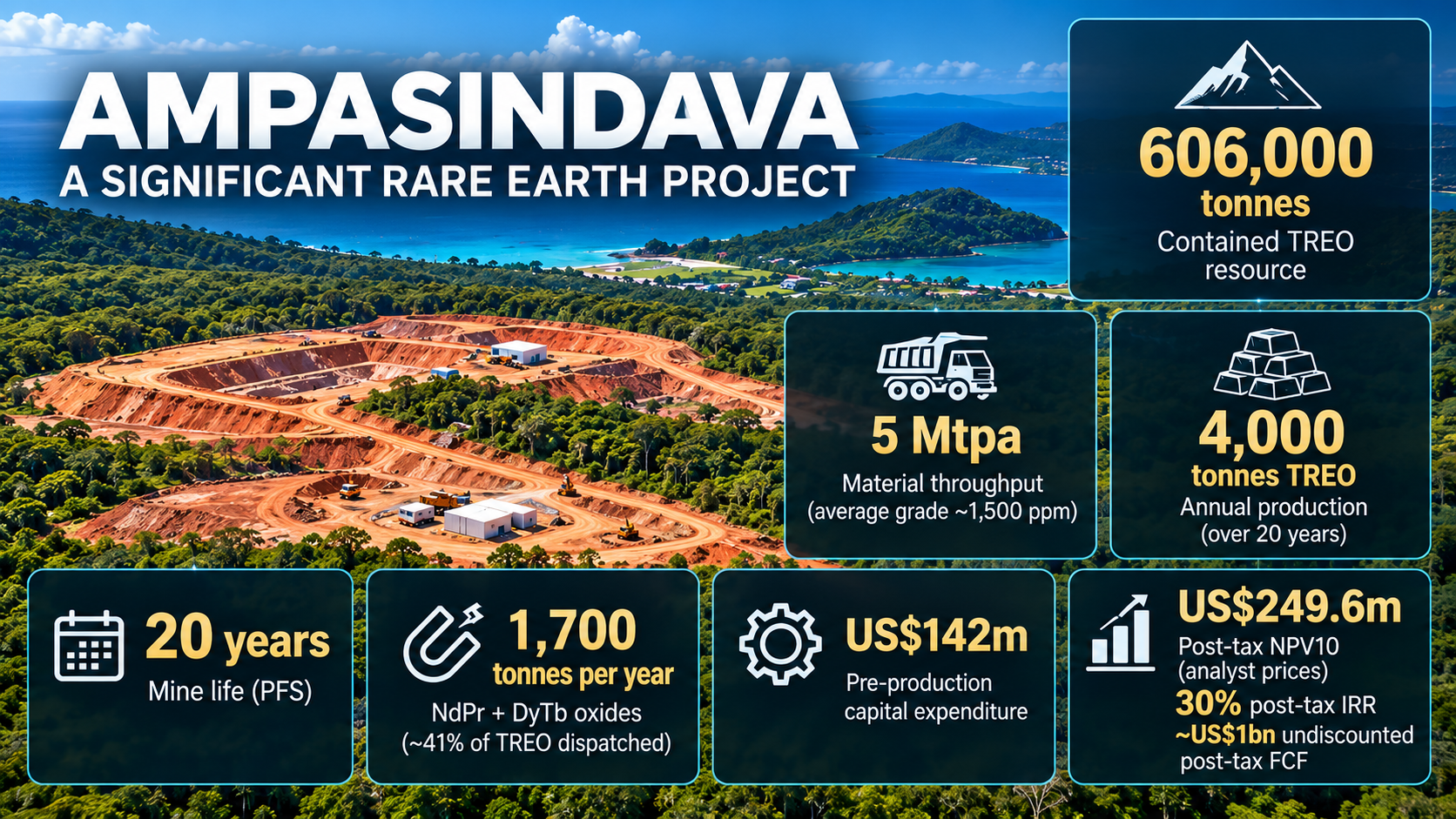
The PFS estimated pre-production capital expenditure of approximately US$142 million.
Using its long-term analyst price assumptions, Harena calculated a post-tax NPV10 of US$249.6 million, a 30% post-tax IRR and approximately US$1 billion of undiscounted post-tax free cash flow over the modelled mine life.
Alternative pricing assumptions produce considerably higher valuations, but we think the analyst-price base case provides the more sensible starting point when assessing the project.
It is also important to distinguish the PFS mine plan from the overall resource.
The approximately 71,000 tonnes of TREO modelled over the 20-year operation represents only part of Ampasindava's much larger ~606,000-tonne contained TREO resource.
That potentially leaves considerable resource optionality beyond the initial development case.
The U.S. Government Has Already Taken an Interest
Perhaps one of the most significant developments at Ampasindava has been the arrival of the U.S. International Development Finance Corporation.
DFC has committed up to US$4.84 million towards Ampasindava's project-development programme.
The funding is earmarked for permitting, environmental and social studies and development of the Proof-of-Concept pilot plant as Harena progresses towards its Definitive Feasibility Study.
Importantly, this followed an extensive engagement and due-diligence process.
The first drawdown is already underway and development work is progressing in Madagascar.
But arguably the most interesting aspect of the agreement is what could potentially come later.
DFC has secured rights to be considered for a larger future financing or investment role as Ampasindava progresses towards a construction decision.
There is no guarantee that further funding will be provided, and investors certainly shouldn't regard Ampasindava's US$142 million construction requirement as already funded.
Nevertheless, having the U.S. Government's international investment arm financially involved potentially gives Harena a more credible route towards future project financing than many junior developers at a comparable stage.
Ampasindava Has Reached the White House Radar
There is another important element to the U.S. connection.
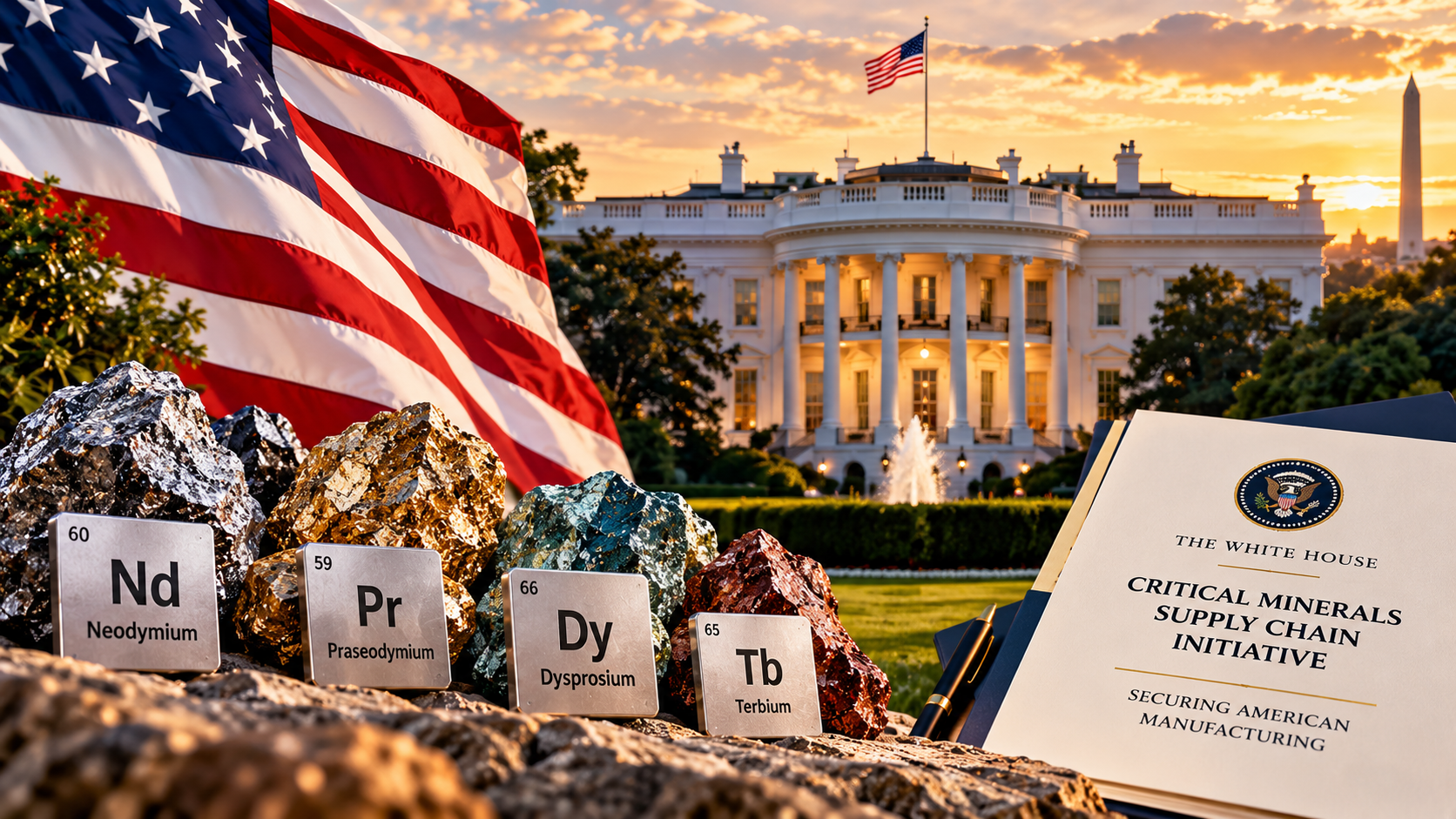
Ampasindava has also been specifically identified as part of U.S. efforts to build more secure critical-mineral supply chains, giving the project a level of geopolitical visibility that is unusual for a junior London-listed mining company.
This matters because the United States is actively seeking alternative sources of the critical minerals required for permanent magnets and advanced technologies, particularly where existing supply chains remain heavily concentrated in China.
DFC's involvement therefore shouldn't necessarily be viewed in isolation.
The agency has described its Ampasindava investment as its first mining investment in Madagascar, while Harena sits alongside other strategic rare-earth investments supported by DFC, including Serra Verde in Brazil.
That comparison becomes particularly interesting given what subsequently happened at Serra Verde.
DFC committed US$565 million of financing to Serra Verde to support expansion of its heavy rare-earth operations.
USA Rare Earth subsequently agreed to acquire Serra Verde in a transaction valued at approximately US$2.8 billion.
Harena is obviously at a much earlier stage and the scale of DFC's US$4.84 million development commitment to Ampasindava is entirely different.
But the strategic pattern is worth recognising.
The U.S. Government is identifying and financially supporting non-Chinese sources of critical rare earths, and Ampasindava is now part of that strategy.
For a company of Harena's size, we think that represents significant external validation of the strategic importance of the asset.
And it raises an interesting longer-term question.
If Ampasindava successfully progresses through its DFC-supported pilot programme, environmental permitting and DFS, how strategically valuable could a large, development-ready source of NdPr, dysprosium and terbium become to companies seeking secure Western-aligned rare-earth supply?
Madagascar Gives Ampasindava the Green Light
The regulatory picture has also moved forward substantially.
Following the signing of the Mining Terms and Conditions with Madagascar's Ministry of Mines in August, Ampasindava's Exploitation Permit has now been formalised.
This is an important distinction.
Harena isn't simply waiting for permission to exploit the mineral resource.
The regulatory framework is now in place for the company to progress the Environmental and Social Impact Assessment, public consultations and associated work required to obtain its Environmental Permit.
The Environmental Permit and completion of the Environmental and Social Management Plans are the key prerequisites before infrastructure construction for the pilot phase can begin.
And this pilot programme is more significant than the term might initially suggest.
Harena intends to establish a demonstration plant and initial commercial operation, designed to validate Ampasindava's technical, operational, economic, environmental and social parameters.
The results will then support completion of the DFS for full-scale development.
Management is currently working towards bringing Ampasindava into production in 2028.
So the project increasingly sits at the intersection of several themes currently attracting strategic capital:
ionic-clay geology, heavy and magnetic rare-earth exposure, substantial resource scale, Western supply-chain diversification, U.S. Government financial support, Malagasy Government support and an increasingly advanced development pathway.
The SmallCapPix Take
Our original interest in Harena centred on the sheer scale and strategic potential of Ampasindava.
Since then, the investment case has changed considerably.
Harena has moved to 100% ownership, completed a PFS demonstrating potentially attractive economics, secured up to US$4.84 million of DFC project-development funding, progressed its Malagasy regulatory approvals and is preparing for a pilot programme ahead of the DFS and a targeted 2028 production start.
Meanwhile, much larger companies are spending hundreds of millions – and in Serra Verde's case billions – securing strategic rare-earth resources.
None of this means somebody is about to buy Harena.
There remain significant milestones ahead, including environmental permitting, successful operation of the pilot programme, completion of the DFS and ultimately securing the substantially larger financing required to build the full-scale project.
But this is precisely why the recent M&A activity is worth watching.
Strategic buyers don't necessarily have to wait until every risk has disappeared before taking an interest in an asset. And as Ampasindava continues to move along the development curve, the number of uncertainties surrounding the project should progressively reduce.
At the same time, the strategic importance of developing Western-aligned supplies of magnet rare earths isn't going away.
With 100% ownership of a very large ionic-clay resource, a defined development case, U.S. Government backing and increasing support from Madagascar, Harena increasingly looks like the type of company that could find itself on the radar of larger players seeking to secure the next generation of rare-earth supply.
Whether that ultimately results in M&A remains to be seen.
But with deal activity accelerating around the sector, Ampasindava looks increasingly difficult to ignore.