
GoldStone Resources: Drilling Success Opens Door to Larger Homase Gold Resource

Fresh gold intercepts, an 850-metre northern extension and a new 7,770-metre exploration programme provide GoldStone Resources with a clearer pathway towards expanding its historic 602,000-ounce gold resource in Ghana.
GoldStone Resources (AIM: GRL) has delivered an encouraging exploration update from its Homase Gold Mine in Ghana, reporting positive drilling results alongside plans for a significantly larger programme aimed at expanding its gold resource.
The announcement marks another step in GoldStone's growth strategy following the £3.51 million strategic investment from Hong Kong-listed Persistence Gold Group earlier this year.
The latest drilling has identified mineralisation extending approximately 850 metres north of the existing Pit 4, confirmed additional parallel mineralised zones and raised the possibility of combining two proposed mining pits into a single operation.
Meanwhile, GoldStone has reappointed SEMS Exploration Services to lead a 7,770-metre drilling programme investigating extensions to the existing resource, both at depth and along strike.
With a historic 602,000-ounce resource already identified, the company is now seeking to establish just how much larger the Homase gold system could become.
What’s New? Encouraging Results From Homase
GoldStone's latest drilling campaign has targeted additional near-surface oxide gold mineralisation that could supply its existing heap-leach operation.
The programme, expanded to approximately 2,700 metres earlier this year, has focused on proposed Pits 5 and 6 north of the existing operations, alongside southern extensions.
Selected drilling highlights include:
-
16 metres at 1.26g/t gold from 11 metres
-
5 metres at 2.76g/t gold from 19 metres, including 2 metres at 4.65g/t
-
8 metres at 2.17g/t gold from 44 metres, including 2 metres at 4.04g/t
-
16 metres at 0.99g/t gold from surface
-
24 metres at 0.68g/t gold from 41 metres
These are not bonanza-grade intersections, but that is not necessarily GoldStone's objective.
The priority is identifying accessible quantities of oxide gold-bearing material that could be mined economically and processed through existing infrastructure.
Relatively shallow mineralisation with encouraging continuity could therefore prove valuable, although mining economics will ultimately depend on grades, recoveries and operating costs.
An 850-Metre Extension Could Support Future Production
One of the most significant findings is mineralisation extending approximately 850 metres north of Pit 4.
Drilling has also identified parallel mineralised zones, with the northern corridor potentially extending up to 200 metres in width.
Importantly, these results raise the possibility of combining proposed Pits 5 and 6 into one larger mining area.
This could simplify mine planning and potentially improve the stripping ratio — the amount of waste rock that must be removed to access gold-bearing ore.
Reducing this ratio can improve mining economics, although detailed modelling is still required.
For GoldStone, identifying additional oxide material beyond existing mining areas could help extend production through its expanded heap-leach infrastructure.
The Bigger Prize: Expanding the 602,000-Ounce Resource
While the latest oxide results are encouraging, the larger investment opportunity lies in the broader Homase gold system.
GoldStone's historic Mineral Resource, reported in November 2012 under the JORC 2004 Code, comprised:
10.6 million tonnes grading 1.77g/t gold, containing approximately 602,000 ounces.
That estimate covered approximately 4.4 kilometres of mineralisation within the Homase Trend.
However, the wider trend extends for more than eight kilometres, based on historical geochemical and geophysical exploration.
Much of this prospective corridor remains insufficiently explored to establish its resource potential.
Furthermore, the historic resource requires updating to account for mining undertaken since 2021 and additional geological information.
GoldStone has previously outlined ambitions to identify a multi-million-ounce resource through further exploration.
The latest announcement provides a more detailed roadmap towards investigating that potential, although any substantial resource expansion remains to be demonstrated.
SEMS Returns With a 7,770-Metre Exploration Plan
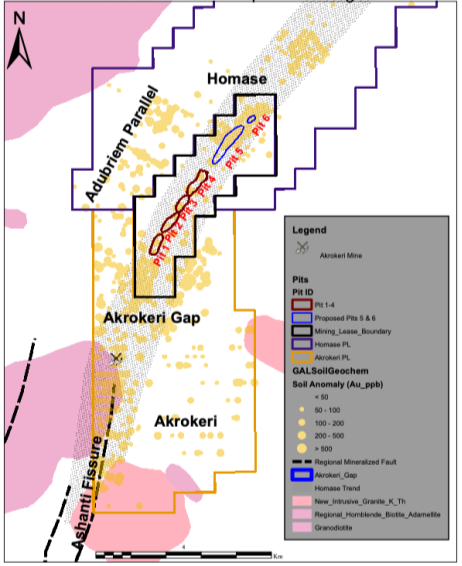 Homase Mine and Exploration Targets
GoldStone has reappointed SEMS Exploration Services, the Ghanaian consultancy responsible for its historic resource estimate, to manage the next exploration phase.
The proposed programme includes:
-
32 reverse circulation and diamond drill holes
-
7,770 metres of planned drilling
-
23 priority holes covering approximately 5,200 metres
-
Four target areas across the Homase mineralised trend
At Pits 5 and 6, drilling will investigate whether recently identified oxide mineralisation continues at depth.
At Pit 4, deeper holes will target known high-grade mineralised shoots approximately 340–380 metres below surface.
Additional drilling beneath Pits 1, 2 and 3 will investigate potential extensions and parallel mineralised structures.
The programme is designed to build a more complete geological picture and support an updated JORC Mineral Resource estimate, now targeted for H1 2027, subject to drilling results and technical studies.
Akrokeri Adds High-Grade Exploration Potential
The broader Homase Trend also includes the historic Akrokeri underground mine, approximately six kilometres south-south-west of the Homase operation.
Akrokeri produced approximately 75,000 ounces of gold in the early 1900s at a reported recovered average grade of around 24g/t gold — an exceptionally high historical grade.
GoldStone is considering further exploration along the corridor connecting Homase and Akrokeri, including the area known as the Akrokeri Gap.
Historical exploration has identified mineralisation within sections of this corridor, although geological continuity remains unproven.
Nevertheless, the combination of near-surface oxide mineralisation at Homase and historically high-grade underground gold at Akrokeri highlights the potential diversity of the wider system.
Strategic Funding Supports the Growth Strategy
The latest drilling plans follow GoldStone's £3.51 million strategic subscription from Hong Kong-listed Persistence Gold Group in July. The investment was at 1 pence per share so a 100% premium to todays share price!
The investment was specifically intended to support expanded drilling, resource development, technical studies and working capital.
GoldStone therefore has fresh financial backing to pursue a more systematic exploration strategy.
Crucially, the company is building upon an existing mining operation, processing infrastructure and an extensive historical geological database rather than pursuing an entirely undeveloped prospect.
The challenge is now to convert this investment into additional resources, improved operational performance and a longer-term mine development plan.
The SmallCapPix Take
GoldStone Resources is building a more compelling exploration-led growth story around its existing Homase gold operation.
The latest results suggest potential to extend near-surface mining areas, while the newly outlined 7,770-metre programme provides a structured approach to investigating the much larger Homase gold system.
The historic 602,000-ounce resource offers an established geological starting point, while the wider eight-kilometre trend and high-grade history of Akrokeri provide additional exploration interest.
With strategic funding secured and SEMS returning to oversee resource evaluation, GoldStone now has a clearer pathway towards testing its longer-term ambitions.
The important catalysts will be further drilling results, mine-planning developments at Pits 5 and 6, improvements in production and the updated JORC resource targeted for H1 2027—plenty of new for investors to watch out for.
The opportunity is to demonstrate that Homase is not simply a small oxide gold operation, but part of a considerably larger mineralised system capable of supporting meaningful long-term growth.
The next phase of drilling will be crucial in establishing whether that potential can translate into additional resource ounces and shareholder value.