
Switch Metals Confirms Lithium Discovery at Issia — With 27 Drill Results Still to Come
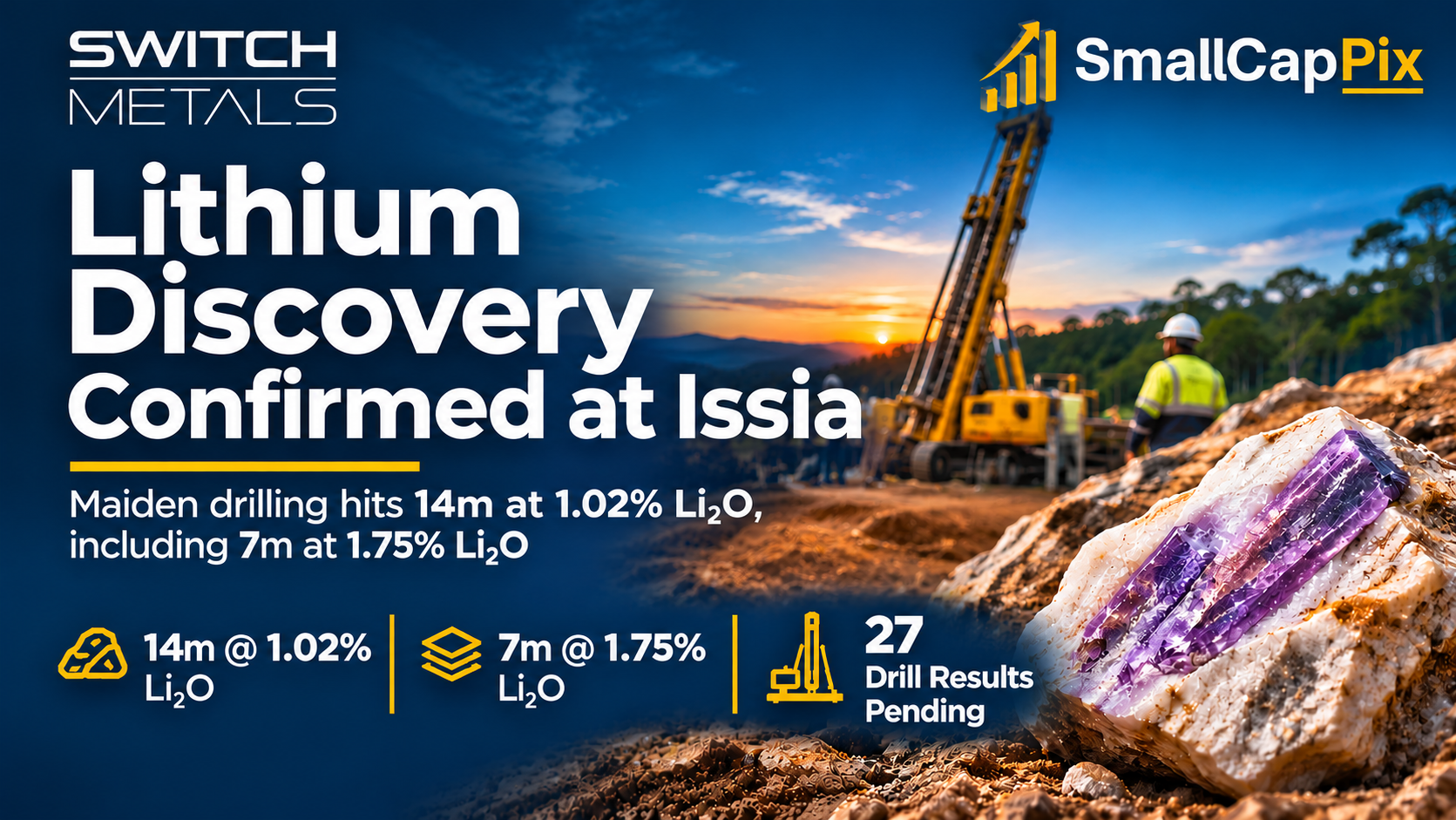
Switch Metals has struck lithium beneath its surface discovery at Issia in Côte d’Ivoire, delivering an impressive maiden drill intercept of 14m at 1.02% Li2O, including 7m at 1.75% Li2O. With 27 drill holes still awaiting results, more than 1.3km of prospective strike and a separate tantalum resource programme advancing towards a maiden MRE, the company is entering a potentially exciting period of exploration news flow.
From Surface Discovery to Drill-Confirmed Lithium
For junior exploration companies, there is an important distinction between identifying high-grade mineralisation at surface and demonstrating that it continues underground.
Switch Metals (AIM:SWT) has now taken that next step.
The company's maiden reverse circulation (RC) drilling programme at its Issia Project has confirmed lithium mineralisation beneath the Kabore spodumene discovery, where earlier surface sampling returned grades of up to 2.8% Li2O.
The results also identify tantalum and niobium mineralisation at both Kabore and Zraty, reinforcing the interpretation of Issia as a potentially extensive critical-metals pegmatite system.
Importantly, these are the first holes ever drilled by Switch in the Issia pegmatite district.
And the programme is far from fully reported.
Of the 34 holes drilled, covering 3,438 metres, assays have been received for just seven, leaving 27 holes awaiting results.
What's New? Kabore Delivers Encouraging Lithium Intercepts
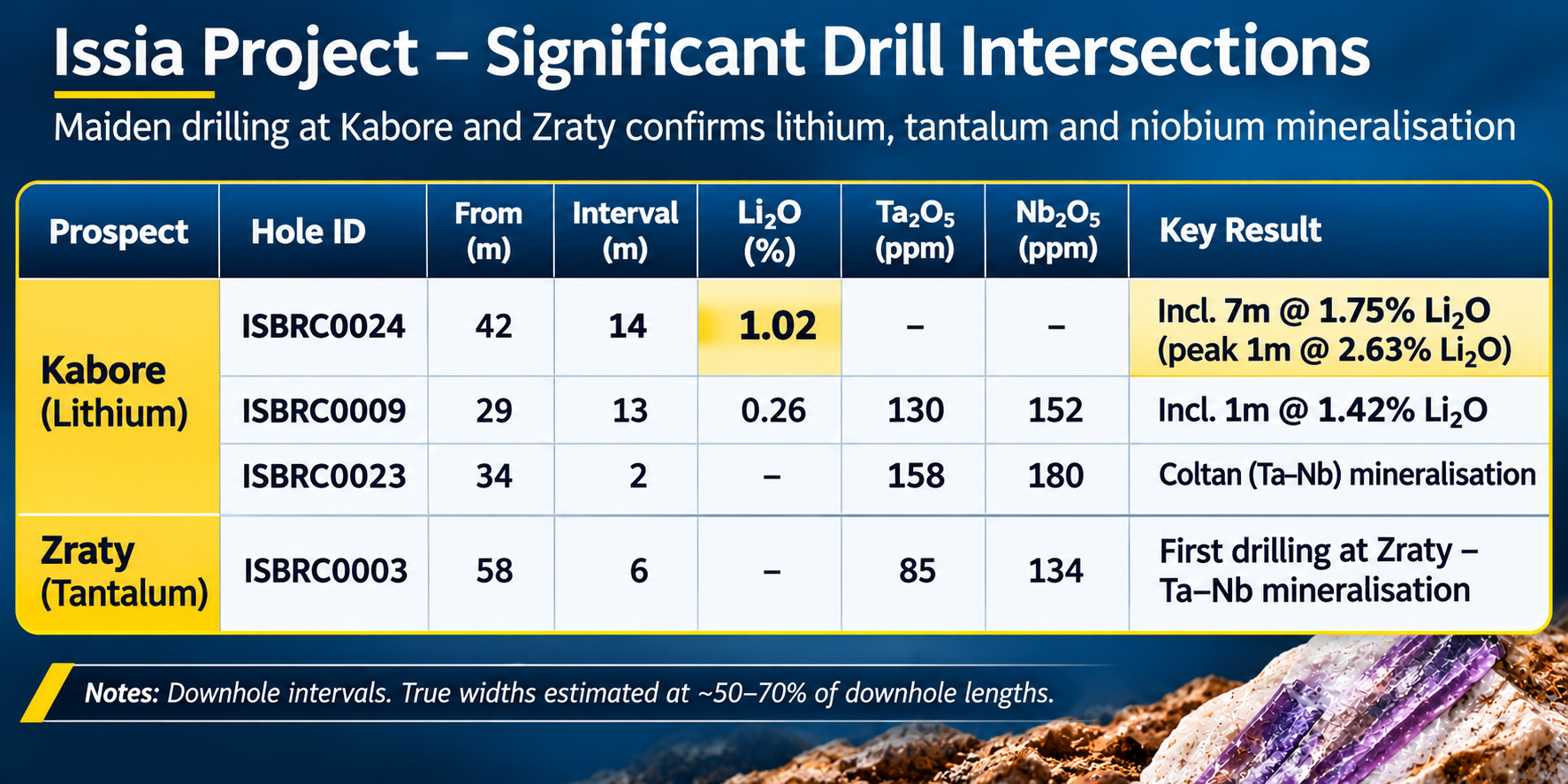
The standout result comes from drill hole ISBRC0024 at Kabore:
-
14m at 1.02% Li2O from 42m
-
Including 7m at 1.75% Li2O from 43m
-
Best individual metre grading 2.63% Li2O
These are encouraging grades for an initial hard-rock lithium exploration programme, particularly given the relatively shallow depths involved.
A second drill hole, ISBRC0009, approximately 200 metres north-east, returned:
-
13m at 0.26% Li2O from 29m
-
Including 1m at 1.42% Li2O
Although the second intersection is lower grade overall, it establishes lithium mineralisation on another drill section, suggesting the discovery is not confined to a single location.
The reported intervals are downhole lengths rather than true widths. Switch estimates that true widths are approximately 50–70% of the downhole intersections, an important consideration when evaluating the scale of the mineralisation.
These early results provide evidence of lithium-bearing pegmatites beneath the surface discovery, although further drilling will be required to establish continuity, thickness and ultimately economic potential.
Only 500 Metres of a 1.3km Prospective Strike Tested
Perhaps the most interesting aspect of the Kabore results is how much of the target remains to be evaluated.
Switch completed 30 RC holes totalling 3,186 metres at Kabore, distributed across seven drill fences spaced approximately 50–100 metres apart.
This initial programme tested approximately 500 metres of a prospective strike extending for more than 1.3 kilometres.
That means less than 40% of the currently identified prospective strike has been covered by scout drilling.
Furthermore, the system remains open at depth and towards the south-west.
The company has launched additional geochemical sampling and mapping to investigate extensions beyond the existing 1.3km target, while the outstanding drill assays should provide considerably more information about the geometry and distribution of the mineralised pegmatites.
Tantalum and Niobium Add Another Dimension
While lithium is likely to attract the headlines, Switch's wider Issia strategy has always included tantalum.
The initial Kabore drilling has identified tantalum and niobium mineralisation in all four holes assayed.
Notable intersections include:
-
6m at 130 ppm Ta2O5 and 152 ppm Nb2O5 in ISBRC0009.
-
2m at 158 ppm Ta2O5 and 180 ppm Nb2O5 in ISBRC0023.
These results support the geological interpretation of Kabore as part of a Lithium-Caesium-Tantalum (LCT) pegmatite system.
Such systems can contain multiple economically interesting metals, although the presence of several commodities does not automatically establish commercial viability.
At Zraty, the company's first drilling has also confirmed tantalum-niobium mineralisation.
The best reported intersection was 6m at 85 ppm Ta2O5 and 134 ppm Nb2O5, including one metre at 112 ppm Ta2O5.
The Bigger Issia Tantalum Story
The hard-rock discoveries are developing alongside Switch's separate shallow tantalum resource programme.
As covered previously by SmallCapPix, the company completed systematic pitting across its initial 2.5km² MRE-1 target area, where preliminary XRF screening indicated a coltan mineralised footprint covering approximately 1.35km², or 54% of the area tested.
A second programme, MRE-2, added another 1.3km² of pitting and sampling, while approximately 7km² of adjacent alluvial drainage basin targets provide further exploration potential.
These shallow programmes are intended to support the company's maiden tantalum Mineral Resource Estimate.
The significance is that Switch is now pursuing two complementary opportunities at Issia:
A shallow tantalum resource development programme alongside a potentially larger hard-rock lithium, tantalum and niobium exploration system.
The geological relationship between the shallow mineralisation and the underlying pegmatites could become increasingly important as exploration progresses.
Independent laboratory results from the shallow tantalum programme are also expected, providing another potential catalyst.
Why Tantalum Matters
Tantalum is an increasingly strategically important metal, valued for its exceptional corrosion resistance, high melting point of approximately 3,017°C and electrical properties.
It is used in miniature capacitors, aerospace components, medical equipment and advanced electronics.
Unlike lithium, tantalum is a relatively small and specialised commodity market, with supply concentrated in a limited number of producing regions.
Its designation as a critical mineral by major Western economies reflects both its industrial importance and concerns over supply security.
For Switch, establishing a commercially viable tantalum resource could therefore provide exposure to a strategically important market that receives considerably less investor attention than lithium or copper.
Another Lithium Opportunity at Tiassalé
The announcement also highlights Switch's separate Tiassalé project in Côte d’Ivoire.
The company reports having identified seven lithium targets at Tiassalé, where operators backed by major Chinese lithium companies are active in the surrounding region.
With Kabore now drill-confirmed, Switch has lithium exploration opportunities at two projects.
Tiassalé remains an exploration opportunity rather than a confirmed lithium resource, but the regional industry activity is worth watching as Switch progresses its own targets.
What Comes Next?
Switch has several potentially important announcements ahead.
27 outstanding drill assays: Results remain pending for 26 holes at Kabore and one at Zraty, with the company expecting the remaining assays by the end of 2026, subject to laboratory turnaround times.
Further Kabore drilling: The full dataset will be interpreted to identify follow-up targets along strike and at depth.
Shallow tantalum assays: Independent laboratory results should help refine the mineralisation model underpinning the maiden resource programme.
Maiden tantalum MRE: Continued infill work and geological modelling are intended to advance Issia towards its first JORC-compliant tantalum resource.
Regional exploration: Mapping, soil sampling and scout auger drilling will continue to investigate extensions and generate new targets.
The SmallCapPix Take
This is an encouraging first set of drilling results for Switch Metals.
The headline intersection of 14m at 1.02% Li2O, including 7m at 1.75% Li2O, confirms that the previously identified surface lithium mineralisation extends underground.
That represents a meaningful progression for an early-stage explorer.
What makes the announcement particularly interesting is that only four of the 30 Kabore drill holes have reported, while the initial drilling has tested just 500 metres of a prospective strike exceeding 1.3km.
There is clearly more information to come and Switch is beginning to build a potentially interesting multi-commodity exploration story.
The company now has drill-confirmed lithium at Kabore, tantalum and niobium mineralisation across two hard-rock prospects, a separate shallow tantalum resource programme approaching a maiden MRE, and additional lithium targets at Tiassalé.
The immediate attraction is the combination of a confirmed lithium discovery and a substantial pipeline of outstanding exploration results.
If the remaining 27 holes demonstrate further encouraging lithium intersections and the tantalum programme progresses towards a meaningful maiden resource, Switch could enter 2027 with a substantially better-defined critical-metals portfolio.
For now, the first drilling results have provided an encouraging start — but the next batch of assays will be crucial in determining just how significant the Kabore discovery might become.