
EGT’s Anemos Analytics Wins New Contract with Constantine Wind Energy
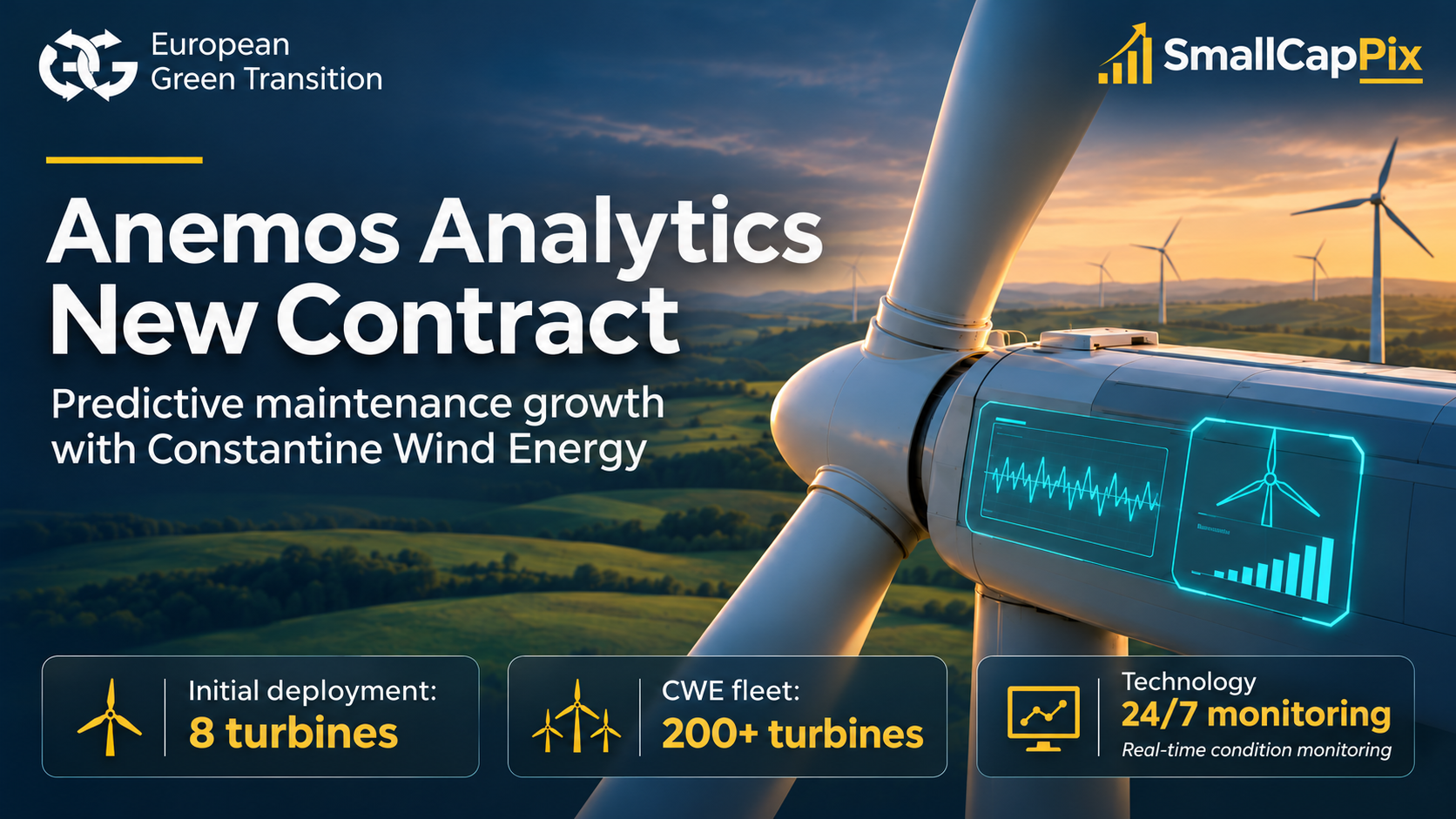
Anemos Analytics has secured an initial eight-turbine deployment with Constantine Wind Energy, providing further validation for its predictive maintenance technology and potential access to a fleet of more than 200 turbines.
European Green Transition plc (AIM:EGT) has announced a new contract for Anemos Analytics, its 79%-owned predictive maintenance business, with Constantine Wind Energy.
The agreement will see Anemos deploy its condition monitoring technology across an initial eight Vestas wind turbines during 2026.
While the initial deployment is relatively small, the more interesting point is the customer. Constantine Wind Energy owns and operates more than 200 wind turbines across Great Britain, meaning the contract could potentially provide Anemos with a much larger opportunity if the technology performs well.
For EGT, the deal provides further commercial validation for a technology business that could become increasingly valuable as wind turbines age and operators look to reduce downtime, extend asset life and improve maintenance efficiency.
What Does Anemos Do?
Anemos provides predictive maintenance and condition monitoring technology for wind turbines.
Its proprietary system uses tri-axial vibration sensors together with high-frequency data capture to monitor turbine components around the clock.
The aim is to identify component degradation before it leads to a major failure.
That can allow operators to plan maintenance earlier, reduce unplanned downtime and potentially avoid more expensive repairs.
This becomes increasingly relevant as turbine fleets age.
Older turbines can remain productive assets for many years, but keeping them operating efficiently requires more proactive maintenance.
Predictive monitoring can therefore help operators extend asset life while improving uptime and controlling maintenance costs.
Further Commercial Validation
The most important part of the announcement is not the initial eight-turbine deployment.
It is the commercial validation.
Constantine Wind Energy is an established operator with a significant turbine portfolio.
Securing a contract with an owner of this scale suggests Anemos is gaining credibility with larger customers.
It also creates potential expansion opportunities.
If the technology demonstrates clear operational and financial benefits across the initial turbines, there may be scope for Anemos to expand further across the CWE fleet.
That is not guaranteed, but it gives EGT a potentially valuable route to growth from an existing customer relationship.
Another Piece of the EGT Platform
Anemos also fits naturally into EGT’s broader Wind Services business.
Earthmill Maintenance, WEP and Silverford already provide maintenance, engineering, repair and repowering services.
Anemos adds a data and monitoring capability.
Together, that creates the potential for EGT to support customers across more of the wind turbine lifecycle.
The model can effectively become:
monitor → identify problems → maintain → repair → repower
That is strategically attractive because it gives EGT multiple opportunities to generate revenue from the same customer base.
A turbine owner initially using Anemos for monitoring could also require maintenance or engineering support, while ageing turbines may eventually become repowering candidates.
Growing Recurring Revenue Potential
Condition monitoring also has the potential to add more recurring revenue to the EGT business model.
Unlike one-off engineering or repowering projects, monitoring services are ongoing.
As the number of contracted turbines grows, Anemos could therefore provide a more predictable revenue stream alongside EGT’s larger project-based activities.
At the end of Q3, Anemos had contracts covering 136 turbines.
The initial CWE deployment takes that number higher again, while also adding another institutional customer to the platform.
Over time, growth in monitoring contracts could improve the overall quality and visibility of Group revenues.
The SmallCapPix Take
This is a relatively small contract in financial terms, but strategically it is another useful step forward for Anemos Analytics.
The initial deployment covers eight turbines, but Constantine Wind Energy operates more than 200.
That means the real opportunity lies in what could follow if Anemos proves its value within the initial rollout.
The contract also reinforces the wider EGT strategy.
Predictive monitoring complements the Group’s maintenance, repair and repowering activities and gives EGT another way to deepen relationships with existing wind turbine owners.
That could become increasingly valuable as the UK’s onshore wind fleet ages and operators focus more heavily on uptime, maintenance efficiency and asset life extension.
Whilst the immediate revenue contribution is modest, continued contract wins with larger operators could help turn Anemos into a meaningful recurring-revenue business within the wider EGT platform.
For now, this looks like another positive piece of commercial validation — and the size of Constantine Wind Energy’s wider fleet makes the relationship worth watching.