
Rome Resources Produces First Tin Concentrate as Kalayi Moves Towards Commercial Mining
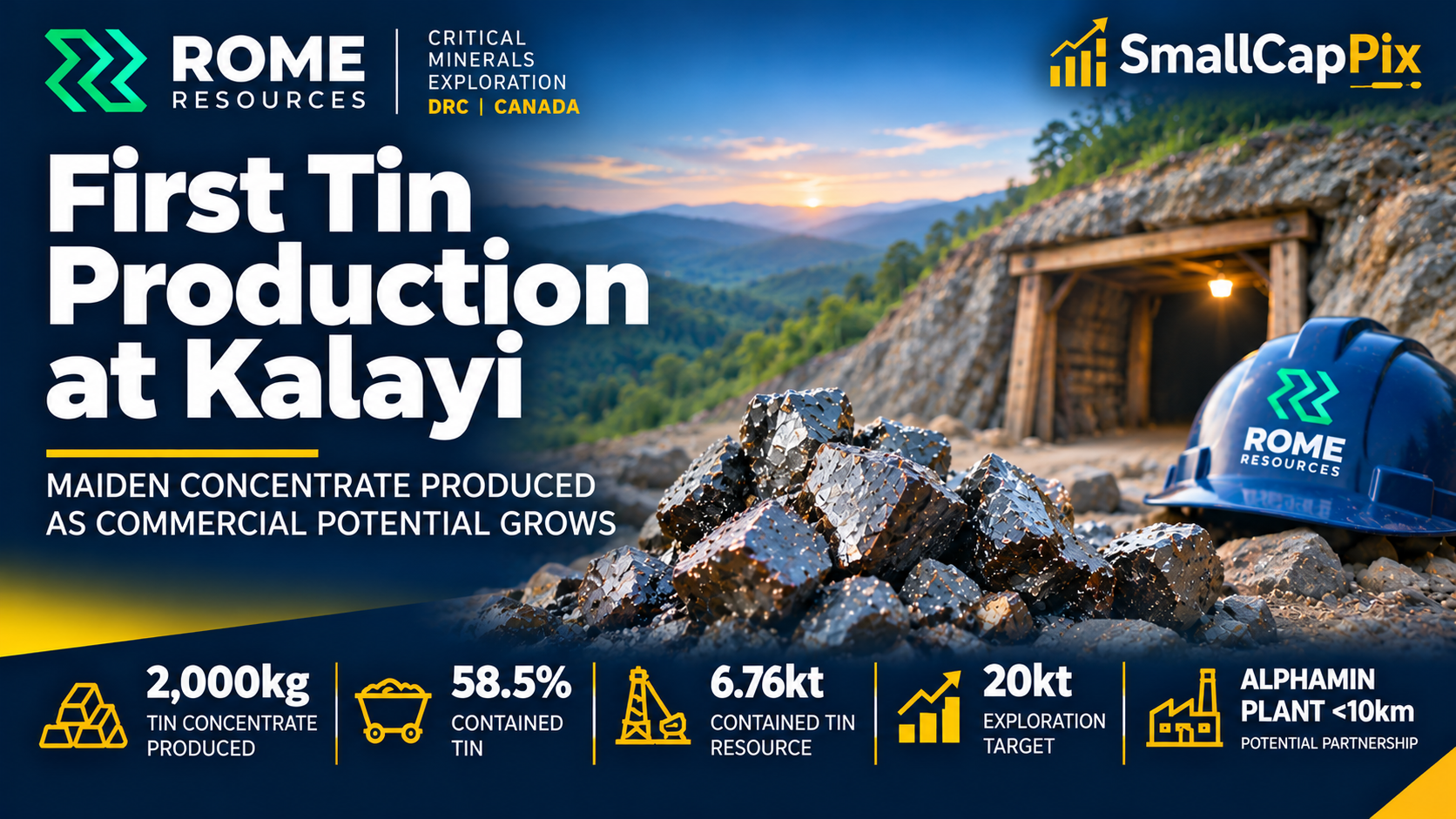
Rome Resources has achieved maiden tin concentrate production at its Kalayi project in the DRC, producing approximately two tonnes of concentrate containing 58.5% tin using simple sorting and sluicing. With near-surface mineralisation, tin prices around $50,000 per tonne and a favourable environmental audit received, Rome sees significant potential to scale production once a full Mining Licence is secured. Meanwhile, nearby Alphamin processing infrastructure could provide another potential route
Rome Resources (AIM: RMR) has reached an important milestone at its Kalayi Tin Project in the Democratic Republic of Congo, successfully producing its first tin concentrate from a pilot mining operation.
The company has produced approximately 2,000kg of concentrate containing 58.5% tin, equivalent to approximately 75% cassiterite.
The concentrate was produced from near-surface mineralisation using straightforward sorting, crushing and sluicing techniques, without requiring flotation, chemical treatment or a complex processing plant.
For Rome, the significance extends beyond the initial production volumes.
The company is beginning to demonstrate a potential pathway from exploration towards commercial tin production.
Why the Simplicity of Processing Matters
One of the most interesting aspects of the announcement is just how straightforward the pilot operation has been.
Mining began in June 2026, with two shallow horizontal tunnels, known as adits, driven into the hillside to access the mineralised zones.
The main workings have focused on Adit 2, where a gallery approximately 12.8 metres long has been developed just 6.4 metres below the surface.
This approach avoids the need for expensive hoisting infrastructure or significant underground pumping systems.
Once extracted, the ore is crushed and passed through a simple sluicing process to separate the heavier cassiterite minerals.
The resulting concentrate was analysed at a regional government laboratory, with samples returning tin grades of 64.82% and 52.15%, averaging approximately 58.5%.
Importantly, the initial two tonnes of concentrate have been produced without a sophisticated processing circuit.
That could have meaningful implications for future operating costs and capital requirements.
CEO Paul Barrett highlighted the commercial opportunity:
"The mineralisation runs from surface, the mining method is straightforward and the processing is simple."
With tin trading at approximately $50,000 per tonne, management believes Kalayi could offer attractive margins if operations can be scaled successfully.
However, the company has not yet published commercial-scale operating costs or a definitive economic assessment.
What Could the First Production Be Worth?
Although the initial volumes are modest, they demonstrate the potential value of the material being recovered.
At a tin price of approximately $50,000 per tonne, the calculation is straightforward:
2,000kg of concentrate × 58.5% contained tin = 1,170kg of tin.
That equates to approximately $58,500 in theoretical gross contained-metal value.
This is not the same as sales revenue or profit. Actual proceeds will depend on concentrate pricing, payability, deductions, transport and other costs.
Rome intends to sell the concentrate at a local facility in Walikale.
While the current operation remains small, the important question is whether this straightforward mining and processing model can be replicated at significantly greater scale.
Two Potential Routes Towards Commercial Production
The most significant immediate constraint at Kalayi is its existing mining permit.
Rome currently operates under a small-scale mining exploitation permit, known as a PEPM, which restricts production volumes.
Conversion to a full Mining Licence would provide longer-term tenure and permit operations at commercial scale.
Encouragingly, Rome has now received a favourable Environmental Audit, representing another step towards securing that licence.
Importantly, the company believes its existing mining and gravity-processing approach could be scaled materially once the regulatory restriction is removed.
That raises the possibility of expanding production without necessarily requiring a complex processing plant.
And What About Alphamin?
There is another potentially interesting dimension to Rome's development strategy.
Alphamin Resources operates established tin processing infrastructure less than 10km from Kalayi, providing a potential opportunity for cooperation.
In previous SmallCapPix interviews, CEO Paul Barrett has discussed the proximity of Alphamin and the possibility of a future partnership or processing arrangement.
Such an agreement could potentially provide Rome with access to established infrastructure and processing expertise, reducing the need to develop every element of a commercial operation independently.
For investors, the attraction is that Rome may have more than one potential commercialisation route:
Scale its own relatively simple mining and gravity-processing operation, or potentially explore cooperation with nearby established infrastructure.
Both options would require further technical, commercial and regulatory work.
Drilling Could Unlock a Much Larger Resource
Alongside pilot production, Rome is preparing another targeted drilling programme at Kalayi.
Construction has begun on the first four priority drill pads, designed to test deeper extensions of previously identified mineralisation.
Two particularly interesting intercepts are:
-
KBDD025: 9.5 metres at 2.05% tin
-
KBDD033: 19.5 metres at 0.52% tin
Both remain open at depth, providing opportunities to expand the known mineralised zones.
Further drilling will investigate a potential southeastern extension identified through geological modelling, while additional targets are being assessed at neighbouring Mont Agoma.
Rome already has three drilling units on site, with preparations underway to ensure they are ready for the next campaign.
Kalayi's Resource Continues to Grow
Kalayi's current Inferred Mineral Resource stands at:
-
0.46 million tonnes of mineralised material
-
1.47% average tin grade
-
6,760 tonnes of contained tin
This follows a 45% increase in contained tin during 2026.
The resource model now incorporates eleven mineralised zones, with further potential beyond the existing resource boundaries.
Management continues to identify 20,000 tonnes of contained tin as a realistic combined exploration target, subject to successful additional drilling and resource definition (some US$1 billion of contained metal value!)
That is nearly three times Kalayi's current contained tin resource, although it should not be interpreted as an established resource or reserve.
Rome also continues discussions with potential strategic partners regarding the wider Bisie North project's development and future financing.
The SmallCapPix Take
This announcement represents a potentially important change in Rome Resources' investment story.
Until now, the focus at Bisie North has largely been on exploration success, resource growth and the potential scale of its tin and copper deposits.
Kalayi has now demonstrated actual tin concentrate production.
The initial volumes are modest, but the ability to produce a relatively high-grade concentrate through simple mining and gravity separation is encouraging.
With tin prices around $50,000 per tonne, there is a potentially attractive commercial opportunity if Rome can establish consistent recoveries, operating costs and production volumes.
The next major milestone is securing the full Mining Licence, which could open the door to materially larger operations.
Crucially, Rome may have flexibility in how it approaches commercial development, either by expanding its own processing operations or potentially exploring cooperation with Alphamin.
Meanwhile, targeted drilling offers further resource growth potential, with several mineralised zones remaining open.
For investors, Rome is beginning to demonstrate that Kalayi may offer more than exploration potential alone — it could provide a pathway towards commercial tin production.
The key now is converting that early operational success into a licensed, scalable and economically sustainable mining business.